
In the spring of 1776, Revolutionary combat had ceased in Massachusetts with the Boston evacuation of the British Army and Loyalists in March. The Continental Congress was meeting in Philadelphia, still undecided on whether to take the rebellious step of throwing off the royal yoke of King George the Third.
On May 10, 1776, a resolve was passed in the Massachusetts Provincial Congress to request each town in the colony to declare, in town meeting, whether their representative should instruct the leaders in Philadelphia to declare independence. In many towns, the language was elevated and verbose. For instance, the inhabitants of Natick, “in town-meeting assembled, do hereby declare, agreeable to the tenor of the aforementioned resolve, that, should the honourable Continental Congress declare these American Colonies independent of the Kingdom of Great Britain, we will, with our lives and fortunes, join with the other inhabitants of this Colony, and with those of the other Colonies, in supporting them in such measure, which we look upon to be both important and necessary, and which if we may be permitted to suggest our opinion, the sooner it is come into the fewer difficulties we shall have to contend with, and the grand object of peace, liberty, and safety, will be more likely speedily to be restored and established in our once happy land.”
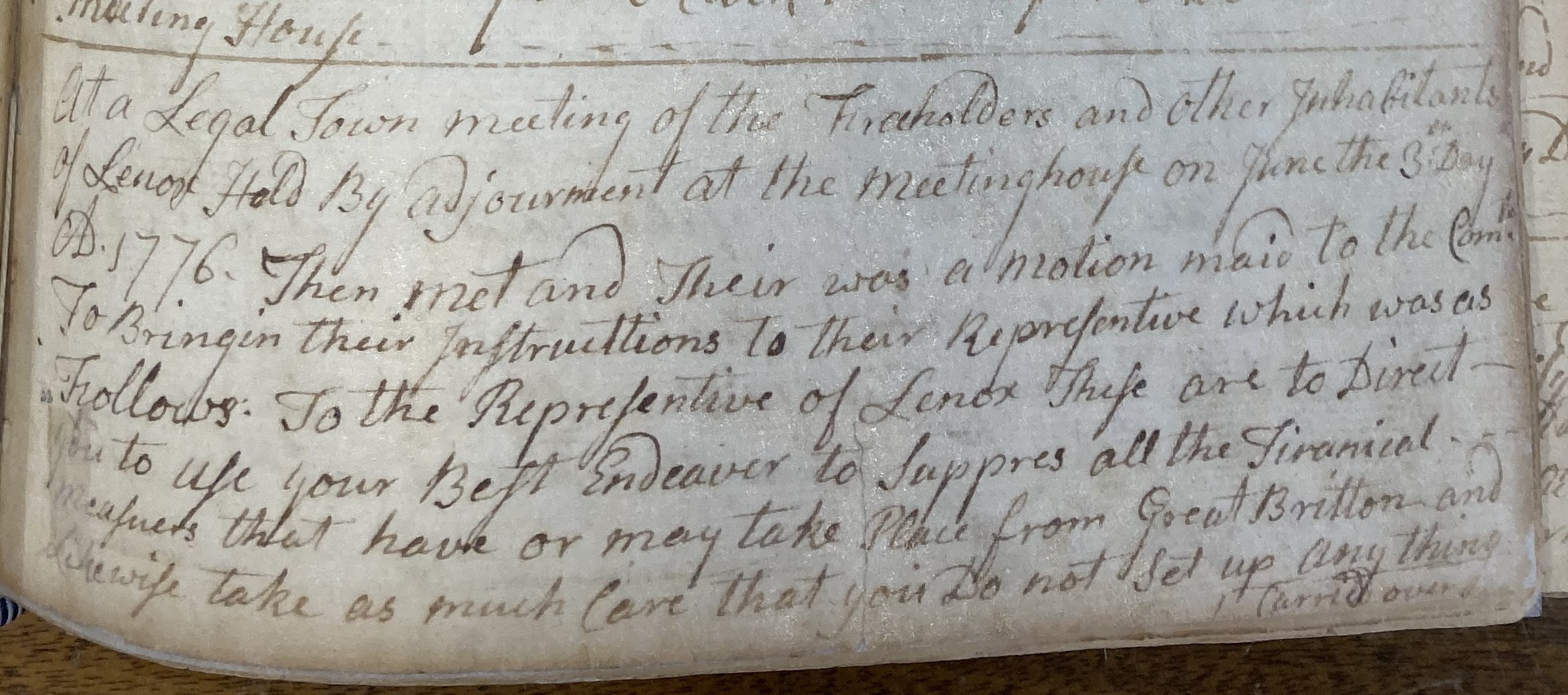 In Lenox, the resolve voted upon in town meeting on June 3, 1776 at the Meeting House was more indicative of a town in the “remotest wilderness corner”: “To the Representive of Lenox These are to Direct you to use your Best Endeavor to Suppres all the Tiranical measures that have or may take Place from Great Britton, and Likewise take as much Care that you Do not Set up anything of a Dispotick Power among our Selves. But Let us have Freedom at home although we have war a Broad. We Do Further Direct you to use your utmost abilities and intris with our assembly and they Theirs with the Continential Congress That if they think it Safe for the Colonies to Declear Independent of the Kingdom of Great Britain and in you so Doing we Do Declare in the above mentioned thing we will stand By you with our Lives and fortens.”
Crucially, the committee of Elias Willard, James Guthrie and James Richards Jr. recognized the danger in shaking off the tyranny of King George only to create an environment for home-grown despots.
Caleb Hyde was the Representative selected for delivering this resolve. He took the place of John Paterson, who was at that time in the field, marching to eventual disaster at the Battle of the Cedars in the failed attempt of the Continentals to capture Quebec.
On May 30, 2026, Local History Librarian Amy Lafave gave a talk at the Church on the Hill titled “Spirits of the Revolution,” on the Revolutionary War soldiers buried in the adjacent cemetery. It was recorded by CTSB. You may watch the video below, or tune in to CTSB channel 1301.